 Change Driving Test
If you have tried to book a driving test recently, you already know the headline. Waits are long. In much of Great Britain the next available slot sits around twenty to twenty three weeks away, and in the busiest urban centres it can be longer still. This is the single biggest frustration learners face, and it shapes almost every decision about when to book, whether to change, and how hard to chase an earlier date. This guide explains how the backlog built up, what is being done about it, and the practical moves that actually work.
Where waits stand now
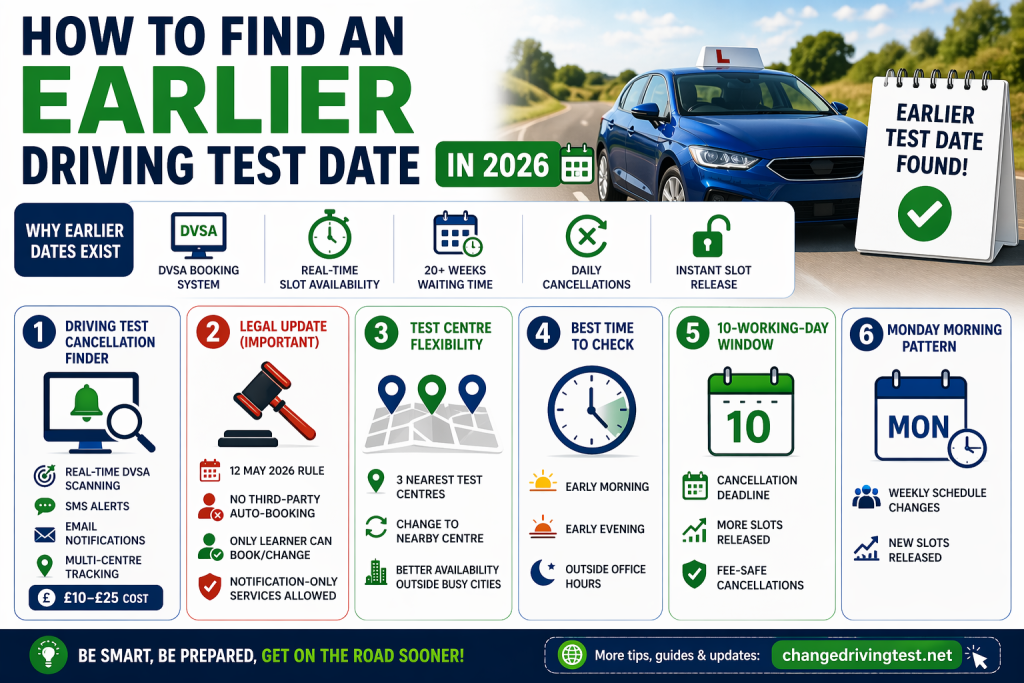
Waiting times vary a lot by location, but the broad picture in 2026 is that most learners face several months between booking and testing. Quieter rural centres tend to have shorter queues than busy city ones, which is why centre flexibility matters so much. The waiting time you see when you first search is really the next slot that nobody has cancelled. Earlier slots exist in the churn of daily cancellations, they are just hard to catch, a theme we return to below and cover in depth in our earlier date guide.
Why the backlog built up
Several forces stacked up at once. The pandemic paused testing entirely for long stretches, creating a deep backlog that the system has never fully cleared. Demand then rebounded strongly, with more learners than ever wanting to drive. On top of that, the booking system itself was being exploited. Automated tools and reseller services grabbed slots in bulk the moment they appeared, holding them to sell on at a profit. That hoarding made the shortage feel even worse, because genuine learners were competing not just with each other but with software designed to beat them to every slot. The result was a queue that was both genuinely long and artificially inflated.
How the 2026 rules help
The 2026 booking changes are aimed squarely at the artificial part of the problem. By making it illegal for third parties to book or manage tests, the rules cut off the bots and resellers that hoarded slots. By limiting changes to two per booking, they stop endless speculative rebooking. And by restricting centre moves to the three nearest, they end the trick of grabbing a slot in a quiet centre and shifting it to a busy one. None of this creates more examiners overnight, so it does not magically clear the underlying backlog, but it does mean the slots that exist reach genuine learners more fairly. Our 2026 rules guide explains each change in full.
Practical ways to beat the queue
Within a long queue, there is still a lot you can do to get tested sooner:
- Watch for cancellations daily. Slots are released constantly as others cancel or rearrange.
- Use a reputable alert service. One that notifies you of matching slots so you can book them yourself.
- Search around the ten working day mark, where cancellations cluster because that is the last point others can cancel without losing their fee.
- Check at off peak times, early morning, early evening and Monday mornings, when fresh slots tend to appear.
- Consider all three of your nearest centres, since their availability can differ by weeks.
Flexibility is your biggest edge
The learners who get tested soonest are almost always the most flexible. If you can accept any of your three nearest centres, any day of the week, and slots at less popular times, you give yourself far more chances to catch an early cancellation. Rigidly insisting on one centre and one specific day, by contrast, can leave you stuck near the back of the queue. Flexibility does not mean accepting something unworkable, you still need a centre you can reach and roads you have practised, but within those limits, the wider you cast your net, the sooner you are likely to be tested.
Readiness beats speed
It is worth saying clearly, because long waits create pressure to grab any slot going. An earlier test only helps if you are ready for it. A fail means another ten working day wait before you can sit again, plus the cost and stress of a fresh attempt, so rushing in unprepared can actually slow you down overall. The DVSA suggests most learners need around forty five hours of professional lessons and twenty hours of private practice. Book when you are consistently passing mock tests, not simply when a date appears. With only two changes per booking, you also do not want to grab an early slot and then have to move it, wasting one of your precious changes. Speed and readiness are not the same thing, and readiness wins.
The legal line on tools
Alert services that notify you of slots are allowed. Auto booking services that log in and book as you are illegal from 12 May 2026 and can get your account suspended. Always book the slot yourself.
This line matters more than ever when you are desperate to escape a long wait, because that desperation is exactly what dubious services prey on. Before 2026, auto booking tools were widespread, so do not assume something is fine just because it was common. If a service touches your login or completes the booking for you, avoid it. Stick to tools that only tell you a slot exists and let you do the booking.
The outlook
The honest picture is that waits will not vanish overnight. Clearing a backlog this deep takes sustained increases in testing capacity, which build slowly. What the 2026 rules do is stop the queue being made worse by hoarding, so the improvement in capacity actually reaches learners rather than touts. In the meantime, your best strategy is entirely in your hands. Get genuinely ready, stay flexible, watch for cancellations, use only legal alert tools, and you can often turn a twenty week wait into something far shorter. When you are ready to act, our earlier date guide gives you the step by step tactics, and our rebooking guide covers what to do if you need a fresh start.
Why centres differ so much
Two test centres a short drive apart can have wildly different waits, and understanding why helps you target the shorter ones. Busy urban centres serve dense populations with many learners and many driving schools, so demand far outstrips the slots available. Quieter suburban and rural centres serve fewer people, so their queues are often shorter, sometimes dramatically so. Examiner numbers, local demand, and how many learners treat a centre as their default all feed into the wait. Because the 2026 rules let you move your test to one of your three nearest centres, the practical takeaway is to look beyond the obvious busy centre and check whether a quieter neighbour has slots weeks sooner.
Scoring your own flexibility
A useful exercise is to honestly rate how flexible you can be, because flexibility maps directly onto how soon you will be tested. Can you accept any of your three nearest centres, or only one? Can you test on any day of the week, including Saturdays, or only certain days? Can you take an early morning or late slot, or only mid morning? Each yes widens your net and shortens your likely wait. Each no narrows it. You do not have to be infinitely flexible, you have to be realistic about your genuine constraints and then make the most of everything outside them. Learners who score high on this exercise consistently get tested sooner than equally ready learners who insist on one centre and one time.
Realistic expectations
It is worth being honest with yourself about timescales. With waits of twenty weeks or more, even an aggressive cancellation hunting strategy is more likely to save you several weeks than to find you a slot tomorrow. That is still a huge improvement, and well worth the effort, but expecting a next day test usually leads to disappointment and risky decisions. Set a target of bringing your test forward by a meaningful margin, plan your practice around being ready in good time anyway, and treat any earlier slot you catch as a bonus rather than the plan. This mindset keeps you both motivated and prepared, which is exactly the combination that leads to a pass.
The long term outlook
Looking ahead, the direction of travel matters as much as the current number. The 2026 rules were designed to stop the queue being inflated by hoarding, so as testing capacity grows, more of that capacity should reach genuine learners rather than leaking to resellers. Clearing a backlog this deep is a slow process that depends on sustained increases in examiner numbers and testing slots, so improvements come gradually rather than overnight. In the meantime, the levers in your hands have not changed: get genuinely ready, stay as flexible as your life allows, watch for cancellations using only legal alert tools, and book the moment a suitable slot appears. Do that, and you give yourself the best possible outcome whatever the headline waiting time happens to be. When you are ready to act, our earlier date guide has the detailed tactics.
The mindset that beats the queue
Long waits test patience as much as skill, and the learners who come through them best share a particular mindset. They accept that the headline waiting time is just the next uncancelled slot, not a fixed sentence, which frees them to go hunting for something sooner. They stay flexible wherever life allows, treating each of their nearest centres and each day of the week as another chance. They use only legal alert tools and book slots themselves, so they never put their account at risk chasing speed. And, importantly, they keep preparing as though the test could come at any time, so that when an earlier slot appears they are ready to take it rather than forced to let it go. That blend of realism, flexibility and readiness is what turns a daunting wait into a manageable one.
Above all, they keep the goal in focus. The aim is not to win a race against the booking system, it is to pass a driving test and earn a licence. An earlier date only serves that aim if you are ready for it. So they invest in their driving first and their slot hunting second, knowing that a confident, well prepared learner with a slightly later date will pass, while an anxious, underprepared one with an early date will likely be back in the queue after a fail. Get ready, stay flexible, hunt sensibly, and the wait, however long it looks today, becomes just one more thing you handled on the way to passing.
Beating the wait, in summary
Long waiting times are the backdrop to almost every driving test decision in 2026, but they are far from the whole story. The headline figure, often twenty to twenty three weeks, is just the next slot nobody has cancelled, and cancellations open up every day. The 2026 rules were designed to stop the queue being inflated by bots and resellers, so the slots that exist now reach genuine learners more fairly, even though clearing the underlying backlog depends on capacity growing over time. Within that picture, the levers in your hands are clear: get genuinely ready, stay as flexible as your life allows across centres, days and times, watch for cancellations using only legal alert tools, and book the moment a suitable slot appears. None of this removes the wait entirely, but together these moves regularly turn a long one into something much shorter.
The mindset matters as much as the tactics. Treat the waiting time as a challenge to manage rather than a sentence to endure, keep preparing as though the test could come at any time so you are ready to seize an early slot, and remember that the real goal is a pass, not merely an earlier date. A confident, well prepared learner with a slightly later slot will earn a licence, while an anxious, underprepared one who grabbed the earliest possible date will likely be back in the queue after a fail. Get ready first and hunt sensibly second, lean on the detailed tactics in our earlier date guide, and the wait becomes just one more thing you handled on the way to passing.
Frequently asked questions
How long is the wait for a driving test in 2026?
Most areas run around twenty to twenty three weeks, with busy urban centres often longer. Quieter rural centres tend to have shorter queues, which is why centre flexibility helps.
Will the 2026 rules reduce waiting times?
They cut the artificial part of the problem by stopping bots and resellers hoarding slots. They do not create more examiners overnight, so the underlying backlog clears only as capacity grows.
What is the fastest legal way to get an earlier test?
Use a reputable alert service that notifies you of cancellations, stay flexible across your three nearest centres, and book the slot yourself. Auto booking services are illegal.
Should I take the earliest slot I can find?
Only if you are ready. A fail means another ten working day wait, and grabbing a too early slot can waste one of your two changes. Readiness beats speed.