 Change Driving Test
Cancelling a driving test is sometimes the sensible choice. Maybe you have realised you are not ready, your circumstances have changed, or you simply will not be in a position to take the test for a while. The good news is that cancelling is straightforward and, if you give enough notice, free. The thing to get right is the timing, because the difference between a full refund and a lost fee comes down to a single deadline. This guide walks through the whole process and shows you exactly how to keep your money.
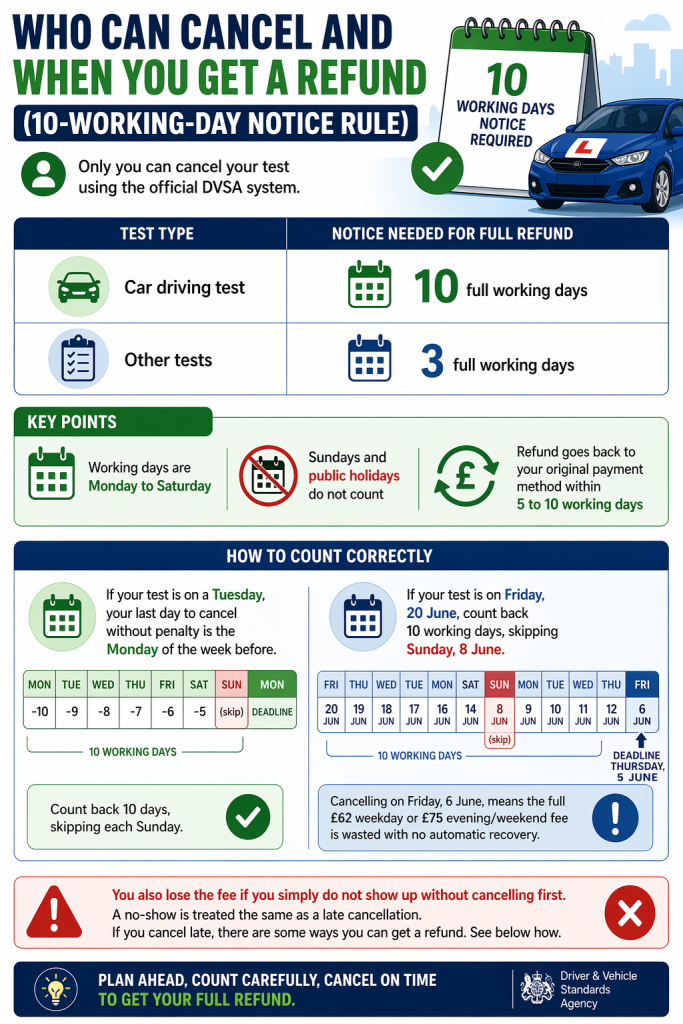
Who can cancel your test
Since the 2026 rules came in, only you, the learner, can cancel a car driving test using the official DVSA system. Your instructor cannot do it for you, and no app or third party service can cancel on your behalf. This protects you from unauthorised changes, but it also means you must keep your own login details safe and handle the cancellation yourself. If you are unsure whether to cancel or simply move the test, read the reschedule section at the end first, because keeping your fee working for you is usually the better outcome.
The refund notice rule
Your refund depends entirely on how much notice you give. The reason you are cancelling does not affect eligibility, only the timing does.
| Test type | Notice needed for a full refund |
|---|---|
| Car driving test | 10 full working days |
| Other tests (theory, motorcycle) | 3 full working days |
Three key points apply across the board. Working days are Monday to Saturday. Sundays and public holidays do not count. And when you are eligible, the refund goes back to your original payment method within five to ten working days. Cancel a car test inside ten working days and you lose the fee, unless you have a genuine reason and apply for a short notice refund, which we cover in a dedicated short notice refund guide.
If you simply do not turn up without cancelling first, it counts as a no show and is treated exactly like a late cancellation. You lose the full fee with no automatic refund and must book and pay again. Always cancel formally, even at the last minute.
How to count the deadline correctly
Counting working days trips people up because Saturdays count but Sundays and bank holidays do not. Two worked examples make it clear.
Example one. If your test is on a Tuesday, your last day to cancel without penalty is roughly the Monday of the week before. Count back, skipping each Sunday, and you land on that Monday.
Example two. If your test is on Friday 20 June, count back ten working days and skip Sunday 8 June. Your deadline is Thursday 5 June. Cancelling on Friday 6 June would waste the full fee, sixty two pounds on a weekday or seventy five at evenings and weekends, with no automatic recovery.
Because bank holidays also drop out of the count, a public holiday in your window pushes the deadline a day earlier. When you are close, do not gamble. Cancel a day or two before your calculated deadline so a miscount or a forgotten bank holiday does not cost you. Always cross check against the official bank holiday calendar before you assume you are safe.
What you need to cancel
Have these ready before you open the cancellation page:
- Your UK driving licence number
- Your driving test reference number, from your booking confirmation email
- Your theory test pass certificate number, if you do not have the reference number
If you cannot find your reference, search your email for a message from the DVSA noreply address, or call 0300 200 1122 with your licence number to recover it.
How to cancel online
Cancellation runs through the same service as changes, at gov.uk/cancel-driving-test, available Monday to Saturday from 6:00 AM to 11:40 PM.
- Log in with your licence number and reference or theory certificate number.
- Find your booking and scroll past the rescheduling options.
- Select Cancel test and confirm. Do not close the page until you receive a confirmation email.
- Keep the confirmation email. It is your proof of the cancellation and its timestamp, which matters if a refund is ever delayed or disputed.
If you are within the eligible notice window, the refund processes automatically. There is no separate form to fill in for a standard, in time cancellation.
The refund timeline
Refunds go back to the card you used to book, typically within five to ten working days. You do not need to provide your bank details again, because the DVSA reverses the original transaction. If your card has expired or changed, most banks redirect the refund to the new card on the same account. If the account is fully closed, the DVSA will contact you to arrange an alternative. If two weeks pass with no refund, contact the DVSA on 0300 200 1122 and have your cancellation confirmation email ready.
When the DVSA cancels your test
Sometimes the cancellation comes from the other side. The DVSA may cancel your appointment for severe weather such as snow, ice, fog or flooding, for examiner illness or emergency, for a test centre problem like a power cut or safety concern, for industrial action, or if your test vehicle fails a safety check on arrival. When the DVSA cancels, the rules work entirely in your favour:
- You are notified by email, and sometimes by phone
- A full refund is issued automatically, no matter how close to the date
- You get priority to rebook
- It does not count toward your two change limit
If the weather looks bad, contact your test centre the evening before and again on the morning of your test, so you are not driving in for nothing.
Should you cancel or reschedule?
This is the most important decision, and many learners get it wrong. If you still intend to take the test but need a different date, reschedule rather than cancel. Rescheduling with more than ten working days notice is free, your fee carries straight over to the new slot, and you keep your place in the queue. Cancelling, by contrast, removes you from the system entirely. You then have to book a fresh test, often joining the back of a months long waiting list, and pay again. Only cancel outright if you genuinely do not know when you will be ready or you need a long break from the process. To move the date instead, follow our step by step change guide. If you have already used both of your changes and cannot reschedule, then cancelling and rebooking is your route, covered in our rebooking guide.
More worked deadline examples
Counting becomes second nature with a few more examples. Remember, working days are Monday to Saturday.
A Monday test. Counting ten working days back from a Monday, skipping the Sundays, your deadline falls around the Thursday or Friday nearly two weeks earlier. Tests early in the week tend to have deadlines that feel surprisingly far back, so do not assume you have more time than you do.
A Saturday test. Saturdays are working days, so a Saturday test is counted the same way as any other. The deadline lands around the Wednesday of the week before. Weekend tests cost the higher fee, so missing the window here loses you more money, making the buffer habit even more worthwhile.
A test with two bank holidays in the window. Each bank holiday removes a day from the count, pushing your deadline earlier. Two of them in your window, as can happen around Christmas or Easter, can move the deadline noticeably. When holidays cluster, count carefully and act early.
Refund troubleshooting
If your refund has not arrived, work through the likely causes before worrying. First, confirm you actually cancelled in time, by checking your cancellation confirmation email and its timestamp. Second, allow the full five to ten working days, since refunds are not instant. Third, remember the money returns to the original card, so check that account rather than a newer one. If your original card has expired, most banks route the refund to the replacement on the same account automatically. If the account is closed entirely, the DVSA will contact you to arrange another method. Only if two weeks pass with no sign of the refund should you call 0300 200 1122, and when you do, have your cancellation confirmation email open so you can quote the date and reference.
Cancel or reschedule, side by side
| Reschedule | Cancel | |
|---|---|---|
| Keep your fee | Yes | Refunded only with notice |
| Keep your place in the queue | Yes | No, rebook from scratch |
| Uses a change | Yes, one of two | No |
| Best when | You still want the test | You need a long break or are unsure |
The table makes the choice obvious in most cases. If you intend to take the test, reschedule. If you genuinely do not know when you will be ready, cancel. The only time cancelling beats rescheduling for someone who still wants the test is when you have used both changes, in which case cancelling and rebooking is your only route, as covered in our rebooking guide.
What counts as a no show
A no show is simply failing to attend without cancelling first, and it is the most expensive mistake of all. You lose the entire fee with no automatic refund, and you must book and pay again from scratch. There is no grace for oversleeping, traffic, or forgetting. A few situations are treated like a no show even if you do turn up: arriving without the right documents, bringing a car that fails the examiner's safety check, or not having valid insurance for your vehicle. The lesson is to always cancel formally if you cannot attend, even at the last minute, and to double check your documents and vehicle the night before. A late cancellation may cost the fee, but it keeps your options open in a way a silent no show never does.
Before you cancel, pause on this
Cancelling feels decisive, but for many learners it is the wrong decisive action. Ask yourself one question first: do I still intend to take this test, just on a different day? If the answer is yes, rescheduling almost always serves you better, because it preserves your fee and your hard won place in the queue, whereas cancelling sends you to the back of a months long line and means paying again later. Cancelling is the right choice only when you genuinely do not know when you will be ready, when you need a real break from the process, or when you have used both changes and have no other route to a new date. Make sure you are in one of those situations before you cancel, rather than reaching for cancellation when a simple reschedule would have kept everything intact.
If you do decide cancelling is right, do it formally and in good time. A formal cancellation, even a late one, always beats a silent no show, which loses the whole fee with no recourse. And if you are cancelling inside the ten working day window because of a real emergency, do not simply accept the loss, check whether you qualify for a short notice refund first, using our short notice refund guide. A few minutes of thought before you click can be the difference between losing your fee and keeping it.
Putting it all together
Cancelling well comes down to three habits. First, count your deadline correctly, remembering working days run Monday to Saturday and bank holidays drop out, then give yourself a day or two of buffer rather than gambling on the exact cut off. Second, choose cancelling only when it genuinely fits, when you need a real break or do not know when you will be ready, and reschedule instead whenever you still intend to take the test, so you keep your fee and your place in the queue. Third, always act formally, because a late cancellation still beats a silent no show, which loses everything with no recourse. Hold those three habits and the refund rules stop being a trap and become simply a timetable you can plan around.
If life forces a late cancellation for a genuine emergency, do not assume the fee is gone. Cancel formally to protect your record, then apply promptly for a short notice refund with solid evidence, as our short notice refund guide explains. And once you are ready to take the test again, our rebooking guide will walk you through getting a fresh booking in place with a clean allowance of two changes. Cancelling is rarely the end of the journey, just a pause, and handled calmly it costs you far less than the panic decisions learners sometimes make at the last minute.
Frequently asked questions
How many working days notice do I need to cancel for a refund?
Ten full working days for a car test, or three for theory and other tests. Working days are Monday to Saturday, excluding Sundays and public holidays.
How long does a driving test refund take?
Refunds go back to your original payment method within five to ten working days. If nothing arrives within two weeks, contact the DVSA on 0300 200 1122.
What happens if I miss my test without cancelling?
It counts as a no show, treated the same as a late cancellation. You lose the full fee with no automatic refund and must book and pay again.
Can I get a refund if I cancel late for a good reason?
You may, for reasons like illness, injury or bereavement, by applying with evidence. See our short notice refund guide.