 Change Driving Test
For years the driving test booking system was easy to game. Slots could be grabbed in bulk, moved freely around the country, and resold at a markup to learners desperate to get tested sooner. Genuine learners lost out, waiting times climbed, and a grey market of bots and reseller apps thrived. In 2026 the DVSA closed those loopholes with four separate rule changes, each arriving on its own date during the first half of the year. This guide explains every change in plain terms and shows you how to work within it.
Why the rules changed
The headline problem was supply. Demand for tests has run far ahead of capacity since the pandemic, and average waits reached around twenty two to twenty four weeks in many parts of Great Britain. When slots are scarce, they become valuable, and value attracts touts. Automated tools scanned the booking system around the clock, booked appointments the moment they appeared, and held them so they could be sold on. A learner who simply wanted a fair shot at a slot was competing against software.
The DVSA response was to put control back with the person actually taking the test. If only the learner can book and manage an appointment, and if appointments cannot be moved freely across the country, the economics of reselling collapse. The rules are not designed to punish ordinary learners. They are designed to make the queue fair. The side effect is that you, the learner, now have to be a little more deliberate about when and how you book.
The four changes and when they landed
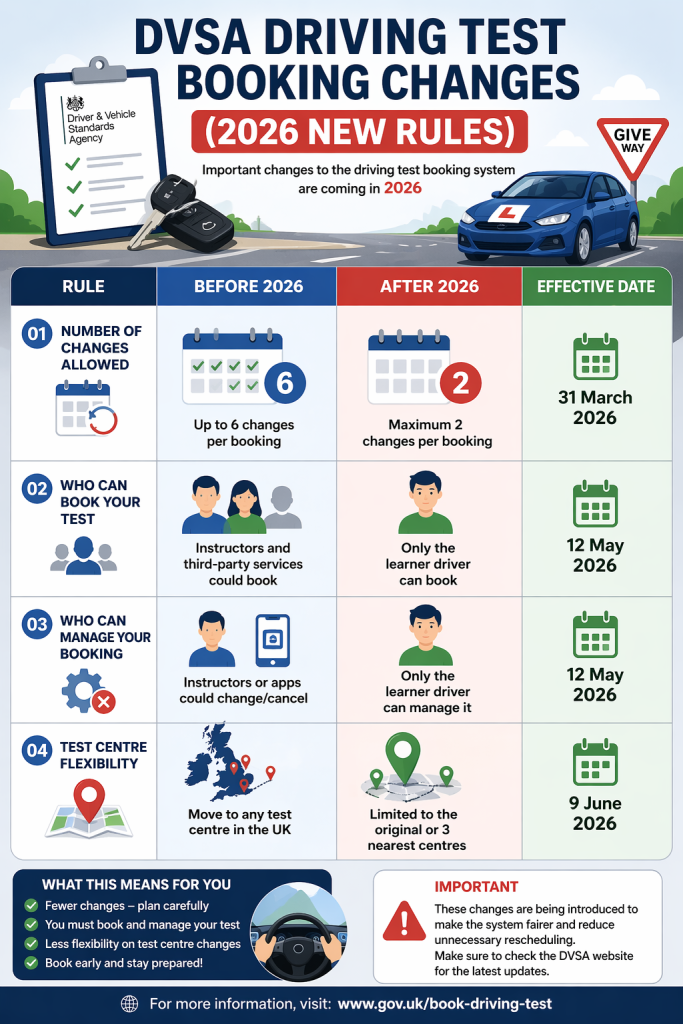
1. A maximum of two changes per booking (from 31 March 2026)
Previously you could amend a booking up to six times. From 31 March 2026 that dropped to two. When the rule came in, every existing booking was reset so that everyone had two changes available, regardless of how many amendments they had made before. Once you have used both, you cannot reschedule that booking again. Your only route to a different date is to cancel and rebook, which we cover in our rebooking guide.
2. Only the learner can book (from 12 May 2026)
From 12 May 2026 it became against the law for anyone other than the learner to book a car driving test. Instructors, driving schools, family members and third party booking firms can no longer create a booking on your behalf. You confirm you are the person taking the test and you agree to the terms and conditions yourself.
3. Only the learner can manage the booking (from 12 May 2026)
The same date extended that principle to managing a booking. Changing, swapping or cancelling a test must now be done by the learner. Apps that used to log in and rearrange tests for pupils can no longer do so legally.
4. Centre changes limited to the three nearest (from 9 June 2026)
From 9 June 2026 you can still book your first test at any centre, but if you then move it, you can only move to one of the three nearest centres to where it is currently booked, or back to the centre you first booked. This stops the tactic of grabbing a slot in a quiet rural centre and shifting it into a busy city later. If you have an existing booking, the rule applies to where your test was booked on 9 June 2026, not where you first booked it.
What counts as a change
Because you only get two, it helps to know exactly what uses one up. Each of the following counts as a single change:
- Changing your test date or time
- Changing your test centre
- Swapping your slot with another learner who already has a booking
Crucially, doing several of these at once still counts as one change. If you move your test from a Tuesday in Northampton to a Friday in Kettering in the same session, that is one change, not two or three. So if you know you want a different date and a different centre, do them together to spend only one of your two allowances.
What does not count toward your limit
Plenty of routine admin does not touch your two changes at all:
- Updating your address or contact details on the booking
- Adding or removing your driving instructor reference number
- Any change the DVSA makes for operational reasons, such as bad weather, examiner illness or a centre problem
This matters because many learners assume any tweak burns a change. It does not. You can keep your details current without worrying about the limit.
How resets work
There are two situations where your allowance returns to two. The first is when the DVSA changes your test. If they move it because of weather or an operational issue, you are reset to two available changes. From 19 June 2026 you can use those reset changes online, where previously you had to phone. The second is when you cancel and rebook. A fresh booking is exactly that, fresh, and it comes with two changes of its own. Bear in mind that cancelling to reset your changes only makes sense if you are willing to risk losing your slot and possibly your fee, so it is rarely worth doing just to unlock more changes.
The third party ban explained
This is the change that trips people up, because so many learners used cancellation finder apps before 2026. The law now says that no one other than you may log into the booking system to book, change, swap or cancel your test. Services that simply watch the system and send you an alert when a slot appears are still allowed, because you are the one who then logs in and books. Services that act as you, entering your details and completing the booking automatically, are not. The DVSA has already suspended online access for many accounts where unusual booking activity was detected, so using a banned auto booking tool risks your own ability to manage your test online. When you read our earlier date guide, keep this distinction in mind: alerts good, auto booking banned.
What it means for instructors
Approved driving instructors have not been pushed out of the process, but their role has shifted from administration to teaching. They can no longer book or move tests for pupils, yet they can still manage their own availability through the DVSA service. By setting the times they are free to take a learner to the test centre, and blocking out holidays, they ensure the system will not let a pupil book a slot the instructor cannot attend. When you add your instructor reference number to your booking, you will only see appointments that match their availability. In practice that makes a good instructor more valuable, not less, because getting the timing right the first time now matters more than ever.
How to plan around the rules
The rules reward preparation. Because changes are scarce and centre moves are limited, the ideal is to book once, at the right time, at a centre you can reach. Wait until you are consistently passing mock tests before you book. If you do need to move your test, decide on the date and the centre together so you spend only one change. Keep more than ten working days in hand whenever possible so any change stays free. And treat your two changes as a small emergency fund rather than a convenience, holding them for genuine shifts in your circumstances. If you ever run out, our cancel and refund guide and rebooking guide will get you back on track.
The rollout timeline in order
Because each change has its own date, it is worth seeing them as a sequence rather than a single event. On 31 March 2026 the change limit fell from six to two, and every existing booking was reset so nobody was caught out mid way. On 12 May 2026 the law changed so that only the learner can book and manage a test, ending years of instructor and third party booking. On 9 June 2026 the geographic restriction landed, tying changes to your three nearest centres. And on 19 June 2026 the system was improved so that changes returned to you after a DVSA cancellation could be used online. Reading them in order makes the logic clear: first limit the volume of changes, then lock control to the learner, then stop slots being moved across the country, then smooth out the admin.
The points people misunderstand most
Bundling changes
The most valuable thing to know is that several changes made in one session count as one. If you want a new date and a new centre, do them together and you spend a single change instead of two. Learners who change the date today and then the centre tomorrow burn both their allowances needlessly.
What a reset really means
A reset returns you to two available changes. It happens when the DVSA changes your test, or when you cancel and book a brand new test. It does not happen just because time has passed or because you would like more changes. Cancelling purely to reset is rarely worth it, because you risk your slot and possibly your fee.
The centre rule and existing bookings
If you already had a booking on 9 June 2026, the three nearest centres are measured from where your test was booked on that date, not from where you originally booked months earlier. This detail matters if your test had already been moved before the rule came in.
What changed for instructors in practice
The shift from instructor booking to learner booking changed the rhythm of lessons. Where an instructor once handled the admin, the learner now does it, which means instructors spend more time guiding pupils on when to book rather than doing it for them. The instructor reference number remains important, because adding it to your booking ensures you only see slots that match your instructor's availability for taking you to the centre. A good instructor will still tell you when you are ready, help you understand the notice windows, and block out their unavailable dates so the system does not let you book a slot they cannot attend. Their influence is now advisory rather than administrative, but for getting the timing right the first time, that advice is more valuable than ever.
Quick reference
| Question | Answer |
|---|---|
| How many changes do I get? | Two per booking |
| Can I get more without rebooking? | Only if the DVSA changes your test (reset to two) |
| Who can manage my booking? | Only you, the learner |
| Where can I move my test? | Your 3 nearest centres or the original |
| Does updating contact details cost a change? | No |
| Does a swap cost a change? | Yes, one each for both learners |
Keep this table in mind whenever you are about to touch your booking. Nearly every mistake learners make traces back to one of these six answers. When you are ready to act on any of them, our change guide and cancel guide walk through the steps.
The thinking behind the rules
It is easier to remember the rules when you understand the single idea behind them: tests should reach the people taking them, not be treated as a tradeable commodity. Every individual change supports that idea. Limiting changes to two stops endless speculative shuffling of slots. Restricting booking and management to the learner removes the middlemen who turned slots into a business. Tying centre moves to your three nearest centres ends the trick of capturing a slot in a quiet area and selling it into a busy one. And resetting your allowance when the DVSA itself disrupts your test keeps the system fair to you when the fault is not yours. Seen this way, the rules are not arbitrary hoops, they are four expressions of one fairness principle.
For the everyday learner, the practical consequence is a small shift in habits. You plan your booking a little more carefully, you handle your own changes, and you treat your two changes as a reserve rather than a convenience. In return, the slots you are competing for are no longer being hoovered up by software the moment they appear. That trade, slightly more care from you in exchange for a fairer queue, is the heart of the 2026 reforms. If you ever need to act on these rules, our change guide, cancel guide and rebooking guide translate them into simple steps.
Frequently asked questions
Do the 2026 rules apply to theory tests?
No. The two change limit, learner only booking and three nearest centre rule apply to practical car tests. Theory tests keep their own rules, including a three working day notice period. See our theory test guide.
If I already used all six changes under the old rules, do I get more?
Yes. All bookings were reset on 31 March 2026 so everyone had two changes available, no matter how many amendments they had made before.
Does changing date and centre at the same time count as two changes?
No. Changing several things in one session counts as a single change.
Can I still move my test to a centre on the other side of the country?
Not from 9 June 2026. You can only move to one of the three nearest centres to your current booking, or back to the centre you first booked.