 Change Driving Test
There is a strange gap in the driving test system. Official waiting times are long, often twenty to twenty three weeks, yet slots open up constantly as other learners cancel or rearrange. The appointments are there. The challenge is that they vanish within minutes of appearing, and the booking system does not hold your hand in finding them. This guide explains where earlier slots come from and the practical, legal ways to grab one in 2026.
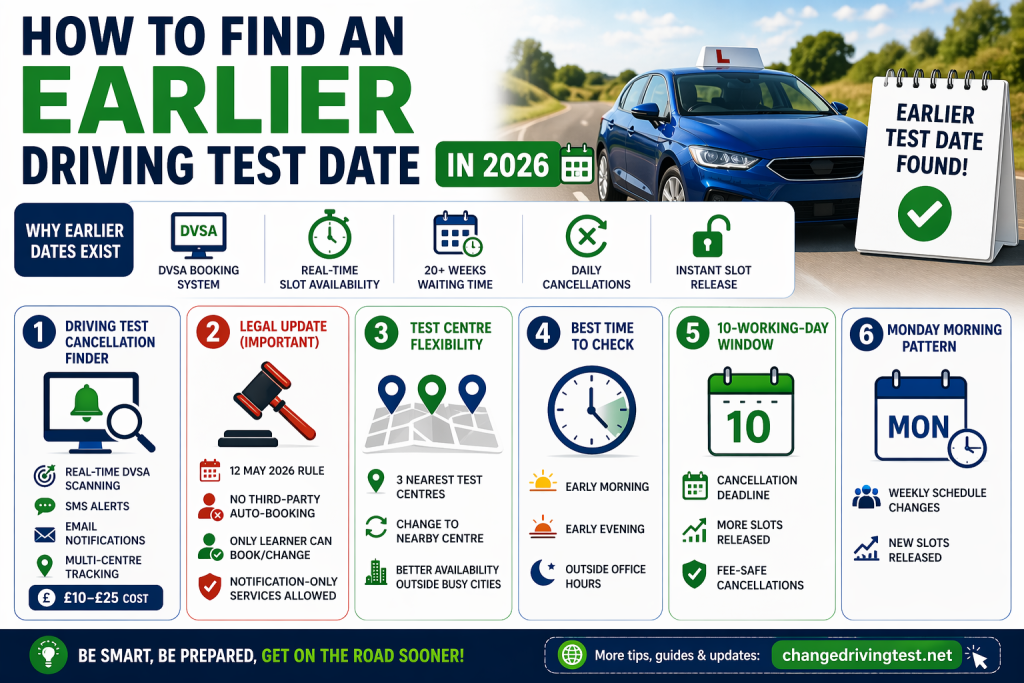
Why earlier slots exist
Every booked test is a slot someone might give up. People change jobs, fall ill, decide they are not ready, or simply find a better date. The moment they cancel or move their test, their old slot returns to the pool and becomes available to everyone. Because thousands of tests are booked across the country, a steady trickle of these released slots appears throughout the day. The booked waiting time you see when you first search is really just the next slot nobody has cancelled yet. The earlier ones are hiding in the churn.
This is why manually refreshing the booking page is such a frustrating strategy. You might catch a slot, but you are competing with everyone else watching the same centre, and the freshest slots are gone almost as soon as they land. To win consistently you need a system, not luck.
Use a cancellation alert service
The single most effective tool is a notification service that watches the booking system for you and alerts you the instant a matching slot appears. Good services scan every few minutes, send alerts by text and email, and let you watch several centres at once. When an alert arrives, you log into the official service yourself and grab the slot. Most of these services charge somewhere between ten and twenty five pounds, which can be worth it if it brings your test forward by weeks.
Choose carefully. The only thing the service should do is notify you. You do the booking. We explain why in the legal section below. If a service promises to book the slot for you automatically, walk away.
Be flexible with your centre
Flexibility is your biggest advantage. Under the 2026 rules you can move your test to one of your three nearest centres, and those three often have very different availability. A busy city centre might be booked solid for months while a quieter centre fifteen minutes away has a slot next week. If you are willing to accept any of your nearby centres, you multiply your chances of finding something soon. Just make sure you can reach the centre on the day and, ideally, that you have driven its local roads. Our step by step change guide shows how the system filters eligible centres for you.
Check at the right times
Cancellations do not appear evenly through the day. A few patterns are worth knowing:
- Early morning and early evening. Many cancellations process outside office hours, so these windows often show the freshest availability.
- Monday mornings. Learners and instructors review their week at the start of it, which tends to release a small wave of slots.
- Around the ten working day mark. See the next section, because this is the single most reliable window.
Watch the ten working day mark
Here is the insider detail. A learner who cancels a car test loses their fee unless they give at least ten working days notice. That deadline is the last moment someone can back out without paying twice, so a noticeable cluster of cancellations happens as people hit it. If you focus your searching around the point where slots are roughly ten working days away from today, you are looking exactly where the fee rule pushes other learners to cancel. It is the closest thing the system has to a predictable supply of fresh slots. To understand the rule from the other side, see our cancel and refund guide.
Stay within the law
From 12 May 2026 it is against the law for any third party service to log into the DVSA system and book or change a test on your behalf. Only use services that notify you of available slots. Avoid any service that claims to auto book by acting as you.
This distinction is simple but vital. An alert service tells you a slot exists and you book it yourself, which is fine. An auto booking service enters your details and completes the booking for you, which is now illegal and can get your account suspended. Before 2026, auto booking tools were common, so do not assume a service is legitimate just because it worked for a friend last year. Read what the service actually does. If it touches your login, steer clear. The full legal picture is in our 2026 rules guide.
Only move it if you are genuinely ready
It is tempting to chase the earliest possible slot, but an earlier test only helps if you are prepared for it. Because you have just two changes per booking, grabbing a slot too soon and then having to move it again wastes one of them. Speak to your instructor before you accept a much earlier date. If you are consistently passing mock tests, go for it. If you are not, bringing the test forward only raises the chance of a fail and the ten working day wait that follows. Use the strategies here to find a slot that is earlier and right, not just earlier.
A quick action checklist
- Confirm with your instructor that you are near test standard.
- Decide which of your three nearest centres you would accept.
- Set up a reputable alert service that only notifies, never books.
- Check early morning, early evening and Monday mornings.
- Focus on slots around ten working days out, where cancellations cluster.
- When an alert arrives, log into the official service yourself and book fast.
- Save your new confirmation email and note your remaining changes.
Bringing a test forward is mostly about being in the right place at the right moment with the right tool. Do that consistently and you can often turn a twenty week wait into a few weeks, entirely within the rules and without paying a tout a penny. For the wider context on why waits are so long, see our waiting times guide.
How alert services actually work
It helps to understand what a good alert service is doing behind the scenes. It repeatedly checks the official booking system for the centres and date range you have chosen. When a slot that matches your criteria appears, it sends you a text or email immediately. That is the whole job. The slot is not held for you, and the service does not book it. You receive the alert, open the official service yourself, and book before someone else does. Because matching slots can vanish within minutes, the value of the service is purely speed of notification. The faster and more frequently it checks, and the quicker it can reach you, the better your odds. None of this involves the service touching your login, which is exactly why it stays within the law.
A centre by centre strategy
Treat your three nearest centres as three separate lotteries with different odds. One may be a busy city centre booked months out, another a quieter suburban or rural centre with far shorter waits. Set your alerts to watch all three, and decide in advance which you would actually accept, factoring in how you will get there and whether you have driven the local roads. When an alert arrives for the quieter centre, you can grab it with confidence because you have already decided it works for you. Hesitation loses slots, so the planning you do now, before any alert arrives, is what lets you act in seconds later.
A realistic week of searching
Here is what a productive week looks like in practice. You check the official service yourself each morning and evening, the times fresh cancellations tend to land. Your alert service runs in the background all day. On Monday you pay particular attention, because learners and instructors review their week and release slots. Throughout the week you keep an eye on slots sitting around ten working days out, because that is where cancellations cluster as others hit their own fee deadline. You do not refresh obsessively for hours, because that rarely beats a good alert service, and you stay ready to book the instant a suitable slot appears. Over a week or two, this rhythm regularly turns a long wait into a much shorter one.
Red flags in dodgy services
A service asks for your driving licence number and booking reference so it can book for you. Promises to guarantee an earlier date. Claims it can auto book the moment a slot appears. Offers to log into the DVSA system on your behalf. All of these describe auto booking, which has been unlawful since 12 May 2026.
The safe test is simple. A legitimate service only ever notifies you. The moment a service wants to act as you, it is on the wrong side of the rules, and using it puts your own account at risk of suspension. Pay for alerts if you like, but never pay for booking, because booking is something only you can legally do. For the full legal background, see our 2026 rules guide, and once you have a slot, our change guide shows you how to lock it in.
The patient, persistent approach that works
Finding an earlier slot is rarely a single lucky strike. It is a habit sustained over a week or two. The learners who succeed treat it as a light daily routine rather than an all day obsession. They check the official service themselves each morning and evening, they let a reputable alert service watch the centres in the background, and they pay extra attention on Monday mornings and around the ten working day mark where cancellations cluster. Crucially, they have already decided which centres and times they will accept, so when a slot appears they book within seconds rather than hesitating and losing it. Speed of decision, backed by preparation, is what separates the learners who bring their test forward from those who watch slots slip away.
Equally important is knowing when to stop chasing. If you are not yet at test standard, an earlier slot is not a prize, it is a faster route to a fail and another ten working day wait. Speak to your instructor honestly about your readiness before you accept a much earlier date. The goal is not simply the earliest possible test, it is the earliest test you can actually pass. Hold both of those in mind together and your hunting becomes purposeful rather than anxious, and far more likely to end in a licence.
After you grab an earlier slot
Catching an earlier slot is a moment to act calmly rather than celebrate too soon. Confirm the new date, time and centre in the confirmation email straight away, and check it is a centre you can genuinely reach and whose roads you have driven. Note how many changes you have used, since moving earlier spends one of your two unless you bundled it with a centre change. Then tell your instructor immediately, so they can confirm they are free to take you and can plan your remaining lessons around the new date. An earlier slot only helps if everything around it lines up, so treat the booking confirmation as the start of a short, focused run up to the test rather than the finish line.
Bring your instructor into the plan
Your instructor is a powerful ally in the hunt for an earlier date, even though they can no longer book the test for you. They know whether you are genuinely at test standard, which is the first question to settle before chasing any earlier slot. They also know the local centres, their typical routes, and which of your nearest options is most forgiving for a learner at your stage. Tell them you are watching for cancellations so they can keep a little flexibility in their diary, and so that when an alert lands you can confirm in moments that they are free to take you. A learner and instructor working together, with the learner doing the booking and the instructor advising on readiness and logistics, is the combination that most reliably turns a long wait into a short one without anyone breaking the rules.
It is worth having an honest conversation about timing too. If your instructor thinks you need another month of practice, an alert for a slot next week is not the opportunity it appears to be. Better to aim your search at the window when you will actually be ready, and to use the intervening lessons to get there. The earliest slot that ends in a pass is always better than an earlier one that ends in a fail and another ten working day wait, so let your instructor's judgement shape not just whether you accept a slot, but which dates you bother watching for in the first place.
Frequently asked questions
Can a service book an earlier test for me automatically?
No. From 12 May 2026 only you can book or change your test. Alert services that notify you of slots are allowed, but any service that logs in and books for you is breaking the law.
How much do cancellation alert services cost?
Most charge between ten and twenty five pounds. They typically scan the system every few minutes and send text and email alerts for slots at the centres you choose.
When is the best time to find a cancellation?
Early morning, early evening and Monday mornings tend to show fresh slots, and cancellations cluster around the ten working day mark, the last point a learner can cancel without losing their fee.
Does grabbing an earlier slot use one of my changes?
Yes. Moving your test to an earlier date uses one of your two changes, unless you combine it with a centre change in the same session, which counts as one.