 Change Driving Test
The ten working day notice rule is strict, but it is not heartless. The DVSA understands that life does not always run to schedule, and it allows learners to apply for a refund when a genuine emergency forces a late cancellation. This is not an automatic refund, and it is not a way to recover the fee simply because you changed your mind. It is a route for real, unavoidable situations, backed by evidence. This guide explains who qualifies and how to make the strongest possible case.
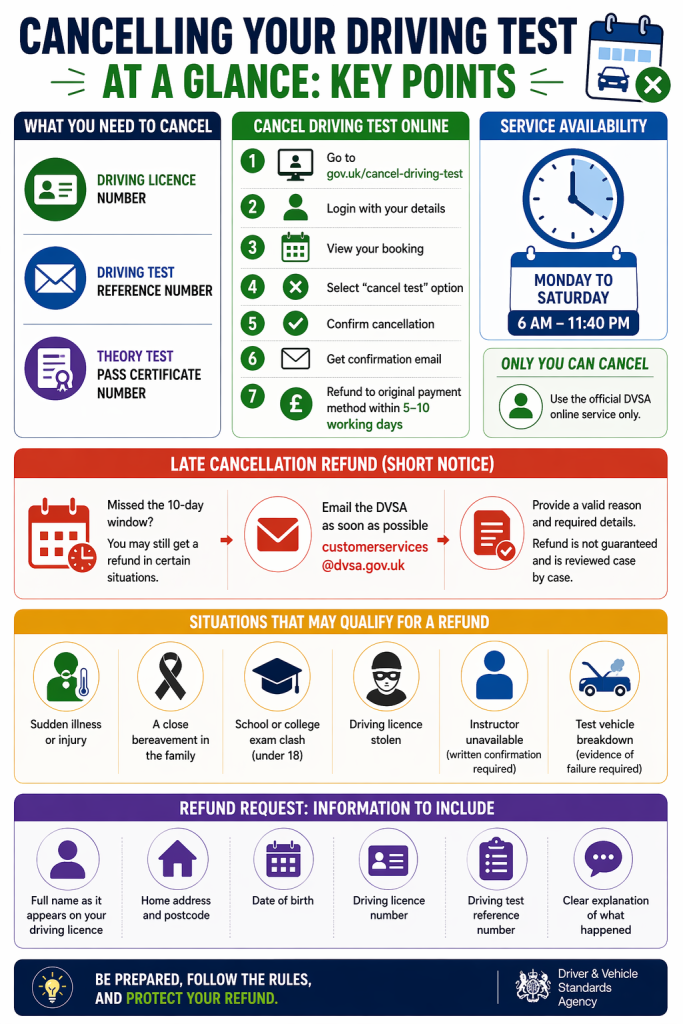
When this applies
This process is for car driving tests cancelled inside the ten working day window, where you would normally lose the fee. If you still have more than ten working days, you do not need any of this, just cancel or reschedule normally using our cancel and refund guide. Before reaching for the cancel button at short notice, check whether you can simply move the test instead. If you still have a change available and the problem is timing rather than a complete inability to attend, rescheduling may solve it without any refund claim at all. If you have used both changes, then a short notice cancellation and refund request is your route.
Reasons that may qualify
The DVSA considers refunds for genuine, unavoidable circumstances. The situations that may qualify include:
- Sudden illness or injury that makes it unsafe for you to drive
- A close bereavement in the family
- A required school or college exam scheduled at the same time, typically for candidates under 18
- Your driving licence was stolen and a replacement could not arrive in time
- Your instructor became unavailable due to illness, with written confirmation from the instructor
- Your test vehicle broke down, with evidence of the mechanical failure
Note that instructor unavailability is treated cautiously, and some routine situations do not qualify. Bad weather is generally handled by the DVSA cancelling the test itself, rather than by a learner refund claim. If in doubt, it costs nothing to apply with honest details and good evidence.
The evidence you need
Evidence is what turns a request into a refund. Match your evidence to your reason:
| Reason | Accepted evidence |
|---|---|
| Illness or injury (7 days or fewer) | Private medical certificate or GP fit note. You may need to pay for this privately. |
| Illness (longer than 7 days) | GP fit note or hospital letter |
| Bereavement | Death certificate or funeral notice |
| Exam clash | Official letter from the school or college confirming the exam date and time |
| Stolen licence | Police crime reference number and the name of the officer handling the case |
| Instructor unavailable | Written confirmation from your instructor |
| Vehicle breakdown | Garage report or equivalent evidence of the mechanical fault |
How to make the request
Send an email to the DVSA as soon as possible after the event. Speed matters, both because evidence is fresher and because it shows the cancellation was genuinely unavoidable.
- Email customerservices@dvsa.gov.uk using the subject line: Unavoidable short notice cancellation.
- Include all the required details listed in the next section, plus your evidence.
- Keep a copy of everything you send and any reply you receive.
- Follow up by phone on 0300 200 1122, Monday to Friday, 8:00 AM to 5:00 PM, if you do not hear back.
What to include in your email
Your email must contain all of the following, or it may be delayed:
- Full name exactly as it appears on your driving licence
- Home address and postcode
- Date of birth
- Driving licence number
- Driving test reference number
- A clear, honest explanation of what happened
- The relevant evidence attached
Write the explanation plainly and stick to the facts. You do not need to be dramatic, you need to be clear and complete. A short, factual account with solid evidence is far stronger than a long, emotional one without proof.
What happens next
The DVSA reviews every request individually and does not guarantee a refund. You should expect a response within five to ten working days by email. If your claim is approved, the refund returns to your original payment method on the usual timeline. If it is declined, you will be told why, and you can ask for the decision to be reviewed if you have further evidence. Either way, you will still need a new booking if you intend to take the test, so read our rebooking guide when you are ready.
Tips to strengthen your claim
- Apply immediately. The sooner you email after the event, the more credible the claim.
- Send complete evidence. A missing crime reference number or an undated medical note slows everything down.
- Be specific. Give dates, times and names where relevant, especially for stolen licences and exam clashes.
- Keep it honest. The DVSA reviews these by hand, and a genuine account with proof is what works.
- Save your confirmation. Your cancellation confirmation email shows exactly when you cancelled, which supports your case.
A short notice refund is never guaranteed, but a complete, prompt, well evidenced request gives you the best possible chance of getting your fee back when something genuinely outside your control gets in the way.
Evidence, reason by reason
Because the decision turns on evidence, it is worth being precise about what each reason needs.
Illness or injury. For a short illness, a private medical certificate or a GP fit note covering the test date is the standard. You may have to pay for a private certificate, and that cost is usually far less than the lost fee. The note should make clear you were unfit to take the test on that day.
Bereavement. A death certificate or a funeral notice naming the date is the usual evidence. The DVSA treats close bereavements with sensitivity, but it still needs documentation to process the refund.
Exam clash. An official letter from the school or college, on headed paper, confirming the exam date and time, is what proves the clash. This route is aimed mainly at younger candidates whose education commitments take priority.
Stolen licence. A police crime reference number and the name of the officer dealing with the case are essential, because they let the DVSA verify the theft. A licence simply lost rather than stolen is treated differently, so be accurate about what happened.
How to structure your email
Write your email so the reviewer can approve it without coming back to you for more. Open by stating plainly that you had to cancel at short notice and you are requesting a refund. Then list your full name, address, date of birth, driving licence number and test reference number, so your booking can be found instantly. Next, explain in two or three factual sentences what happened and why it was unavoidable, including the relevant date. Finally, note the evidence you have attached. Close politely. The whole email can be short. What matters is that it is complete, factual, and accompanied by proof. A reviewer who has every detail in front of them can say yes quickly. One who has to chase missing information takes longer and may not approve it at all.
What weakens a claim
Some things make a refund less likely, and it is worth knowing them. Delay weakens a claim, because applying weeks after the event looks less like an emergency. Missing or vague evidence weakens it, since the DVSA cannot verify what it cannot see. Reasons within your control weaken it, such as deciding you were not ready, or arranging a holiday after booking. And inconsistency weakens it, so make sure the dates in your explanation match the dates on your evidence. The strongest claims are prompt, fully evidenced, genuinely unavoidable, and internally consistent. If your situation does not fit, it may be more realistic to accept the lost fee and focus on rebooking, covered in our rebooking guide.
Setting your expectations
Approach the process hopeful but realistic. The short notice refund route exists for real emergencies, and when it applies and is well evidenced, it works. But it is discretionary, reviewed by a person, and never guaranteed. Expect a decision within five to ten working days. While you wait, do not let your driving lapse if you still intend to take the test, and remember you will need a new booking either way. If the refund comes through, treat it as a relief rather than something you were entitled to by default. If it does not, you will at least know you made the strongest possible case. Keep copies of everything throughout, because a clear record is your best support if you need to ask for the decision to be reviewed.
Why acting fast matters most
If there is one principle that runs through every successful short notice refund, it is speed. The sooner you contact the DVSA after the event that forced your cancellation, the stronger your position. Prompt contact looks like what it is, a genuine response to an unavoidable situation, whereas a request sent weeks later invites questions about why you waited. Speed also means your evidence is fresh and easy to gather, the medical note still recent, the crime reference number still to hand, the exam letter still in your bag. So the moment you know you cannot attend, do two things in quick succession: cancel the test formally so you are not recorded as a no show, and start preparing your refund email with the evidence attached. The cancellation protects your record, and the prompt, evidenced email gives you the best chance of getting your money back.
While you wait for a decision, keep moving forward as if you will still need the test, because you will. Keep practising if you intend to take it, and be ready to rebook once you are well again or the crisis has passed. A refund, if granted, is a welcome relief rather than a reason to pause your progress. And whatever the outcome, keep copies of every email and document, since a complete record is your strongest support if you ever need to ask for the decision to be looked at again. Calm, prompt, fully evidenced action is the whole game here.
The strongest possible claim
Everything about short notice refunds points back to a single idea: make it easy for the reviewer to say yes. That means applying immediately, while the emergency is fresh and clearly unavoidable. It means sending complete, consistent evidence whose dates match your account exactly. It means writing a short, factual email containing every personal and booking detail the DVSA needs, so nobody has to come back to you for missing information. And it means being honest about whether your situation truly fits, because the route is for genuine emergencies like illness, bereavement, an exam clash or a stolen licence, not for changes of mind. A claim that ticks all of these boxes has the best possible chance, even though no claim is ever guaranteed.
While the decision is pending, keep your record clean and your options open. You cancelled formally, so you are not a no show. You have copies of everything you sent. And you are ready to rebook whether or not the refund comes through, because the test still needs taking if you intend to drive. Approach the whole process calmly and methodically and you remove the only variables within your control. The rest sits with the reviewer, and a prompt, complete, well evidenced request is the most you can do to tilt that decision in your favour. If it does not succeed, you will at least know the case you made was as strong as it could be, and our rebooking guide will help you get straight back on track.
Finally, keep the whole thing in proportion. A lost test fee is frustrating, but it is a modest sum against the value of the licence at the end of the journey, and a single setback does not change your ability to drive or to pass. If the refund comes through, it is a welcome bonus. If it does not, accept it, rebook when you are well or the crisis has passed, and put your energy into the test itself. The learners who handle short notice emergencies best are the ones who make the strongest possible claim, then let it go and refocus on driving, rather than dwelling on a decision that is no longer in their hands. Calm, prompt action followed by a clear head is the right response from start to finish.
Frequently asked questions
Will the DVSA definitely refund a short notice cancellation?
No. Every request is reviewed individually and a refund is not guaranteed. The stronger and more complete your evidence, the better your chances.
What subject line should I use?
Use Unavoidable short notice cancellation when you email customerservices@dvsa.gov.uk, and include all your personal and booking details plus evidence.
How long does a short notice refund decision take?
Expect a response within five to ten working days by email. You can follow up by phone on 0300 200 1122 if you do not hear back.
Does bad weather qualify for a short notice refund claim?
Usually the DVSA cancels the test itself in bad weather and refunds you automatically, rather than you needing to claim. Weather is generally not a learner refund reason.